





Go Further, Faster: The Best Electric Motor for Bike
Finding the best electric motor for bike can change how you ride. Are you tired of tough hills and long commutes? This upgrade gives you the power to go further and feel great.
It doesn’t replace the joy of pedaling. It enhances it. This guide is your simple map to finding the perfect motor. We will look at hub and mid-drive motors. We will explain what watts and torque mean for your ride. We will also guide you through conversion kits. Let’s get you ready to ride smarter.
What Is an Electric Bike Motor and Why Consider One?
I remember my old commute. It was a hilly, ten-mile ride. It left me drained before my workday even started. I loved cycling, but the daily grind was hard. That’s when I found the electric bike motor.
It wasn’t about replacing pedaling. It was about making it better. Hills were no longer obstacles. I arrived at work feeling energized, not tired.
A motor for an electric bike gives you that extra boost. You can build a custom ride. Or you can upgrade your old bicycle with an e-bike conversion kit. You are adding a powerful helper to your pedals. The goal is simple: make your ride smoother, longer, and more fun.
“Adding an electric motor didn’t make me love cycling less. I made me love it more. I could go further and see more than ever before.”

An electric hub motor seamlessly integrated into a bike’s rear wheel.
The beauty of this technology lies in its versatility. You can find options ranging from a simple bike motor for adults to a more robust electric motor for mountain bike use. The goal is the same: to make your ride smoother, longer, and more enjoyable. It transforms a regular bicycle electric motor into a powerful tool for commuting, exercise, or pure adventure.
Ready to Transform Your Ride?
Discover how the right motor can completely change your cycling experience. Explore the different types and find the perfect fit for your bike and your lifestyle.
“Adding an electric motor didn’t make me love cycling less. It made me love it more because I could go further and see more than ever before.”
If you’re completely new to motor categories and terminology, start here: New to motor types? See our Electric Bike Motor Guide → /electric-bike-motor/
Hub Motor vs. Mid-Drive: The Great E-Bike Debate
Once you decide to get an electric motor ebike, the first big question you’ll face is where the motor should go. The two main players in the game are hub motors and mid-drive motors. Each has passionate fans and distinct advantages depending on your riding style, terrain, and budget. To be honest, I spent weeks weighing the front or rear wheel motor debate before making my own choice.
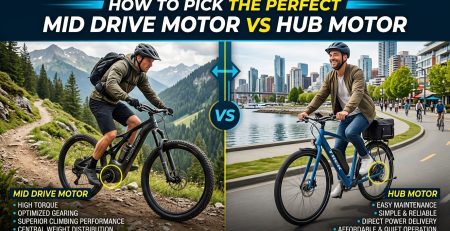
A hub motor for bike is located in the center of either the front or rear wheel. It’s a self-contained unit that directly powers the wheel it’s in. This design is often simpler and more affordable. In contrast, a mid drive ebike motor is positioned at the bike’s crank—where your pedals are—and it powers the drivetrain directly. This allows it to leverage your bike’s existing gears for optimal efficiency, especially on hills.
Visual breakdown: The central placement of a mid-drive motor versus a wheel-based hub motor.
What is a Hub Motor?
A hub motor is an all-in-one unit. It sits in the center of your front or rear wheel. It powers that wheel directly. It works separately from your bike’s gears. This design is often simple, reliable, and costs less.
- Front Hub Motor: This motor is in the front wheel. It pulls you forward. This feels like an “all-wheel-drive” bike.
- Pros: Easy to install. Good weight balance. Low maintenance.
- Cons: Less grip on loose ground. Can affect steering a little.
- Rear Hub Motor: This is the most common type. It is in the rear wheel. It pushes you forward. This feels like a normal bike.
- Pros: Great grip. Works with powerful motors. Feels natural.
- Cons: Harder to change a rear flat tire.
What is a Mid-Drive Motor?
A mid-drive motor sits at the crank, where you pedal. It does not power the wheel directly. It sends power through your bike’s chain and gears. This is a big advantage. The motor can use your bike’s gears for more power.
- Pros:
- Great for Hills: It uses your bike’s gears. This gives it amazing power for climbing the steepest hills.
- Balanced Feel: The motor is low and in the center. This makes the electric bicycle feel stable and easy to ride.
- Very Efficient: It works at the best speed more often. This leads to better battery life and range.
- Cons:
- Higher Cost: Mid-drive systems usually cost more.
- More Wear on Parts: The motor puts more stress on your chain and gears.
- Harder to Install: It often needs special tools to install.
Key Differences at a Glance
To make it clearer, let’s break down the core differences between a front hub motor, a rear hub motor, and a mid-drive motor.
| Feature | Front Hub Motor | Rear Hub Motor | Mid-Drive Motor |
|---|---|---|---|
| Feel | Pulls you forward (all-wheel-drive feel) | Pushes you forward (traditional feel) | Natural, amplified pedaling feel |
| Best For | Flat terrain, commuting, affordability | All-around use, higher power setups | Hills, off-road, performance riding |
| Installation | Easiest to install | Moderately easy | More complex, often requires special tools |
| Pros | Simple, low maintenance, budget-friendly | Good traction, compatible with powerful motors | Excellent efficiency, great for climbing, balanced weight |
| Cons | Less traction, can affect steering | Makes changing a flat tire harder | Higher cost, more wear on drivetrain components |
A Rider’s Insight: Why I Chose a Rear Hub Motor
For my own bike, I mostly ride on city streets with some hills. A mid-drive motor climbs great, which was tempting. But I chose a high-quality rear hub motor. It was simpler and a better value. It gives me a nice push from behind. And it doesn’t make my bike’s parts too complex. It is the perfect mix of power and ease for my daily needs.
How to Choose the Right Electric Motor & Kit for You
So, how do you pick the perfect motor for your bike? Think about three things: your bike, your riding style, and your budget. Choosing an electric motor can feel confusing, but it’s easy if you know what you need.
Step 1: Match the Motor to Your Rides
Be honest about where you ride.
- For City Commuters: Do you ride on flat city streets? A 250W to 500W hub motor is a perfect, low-cost choice. It gives you enough of a boost for city riding.
- For Hill Climbers: Do you live in a hilly area or love trails? A 750W+ mid-drive motor is your best friend. It uses your bike’s gears to give you the torque needed for steep climbs.
- For All-Rounders: Do you ride on a mix of paths and hills? A 500W-750W rear hub motor is a great balance of power, simplicity, and cost.
Step 2: Look Beyond Watts. Think Torque and Battery
Watts are a common measure, but they don’t tell the full story.
- Torque is for Climbing: Torque is turning power. It is measured in Newton-meters (Nm). It gets you moving and pushes you up hills. A motor with 80 Nm of torque feels much stronger on a hill than one with 50 Nm. For hills, look for higher torque.
- Your Battery is Your Fuel: A motor needs a good battery. Look at the battery’s voltage (V) and amp-hours (Ah).
- Voltage (V): Think of this as “power.” Higher voltage (like 48V) gives a more punchy feel.
- Amp-Hours (Ah): This is your “fuel tank.” More Ah means more range. A 17Ah battery will last much longer than a 10Ah battery.
Quick Guide: Choosing the Right Voltage
Matching your motor’s voltage to your riding needs is critical for performance. Data based on typical 2025 kit specs.
| Voltage | Best For | Typical Top Speed* | Torque Feel |
|---|---|---|---|
| 36V | Flat City Commuting | 20 mph (32 km/h) | Moderate (Smooth) |
| 48V | Hills & All-Round | 28 mph (45 km/h) | Strong (Punchy) |
| 52V | Performance/Off-Road | 30+ mph (50+ km/h) | Maximum (Aggressive) |
*Check local e-bike laws regarding speed limits.
Note on Torque vs. Watts: Higher voltage increases top speed, but higher amps and gearing determine climbing power. For hill climbing, prioritize torque (Nm) specs over just top speed.
Why High Torque Matters for Heavy Riders
If you are a heavier rider or plan to carry heavy cargo, raw wattage isn’t the only number that matters. You need torque. While a standard bicycle electric motor might struggle on inclines, a high-torque system (80Nm+) ensures you don’t stall.
For riders over 220 lbs (100 kg), we strongly recommend a mid-drive motor like the Bafang BBSHD. Unlike hub motors, mid-drives use your bike’s gears to multiply force, making them the best electric motor for heavy riders tackling steep hills.
Step 3: Find the Perfect Conversion Kit
An electric bicycle conversion kit is the best way to upgrade your bike. A good kit has all the parts you need. This includes the motor, battery, controller, display, and wires. It makes sure all parts work well together.
Our Recommended Motor Kits
Ready to start your project? Here are our top picks. They are tested for great performance and reliability.
BEST FOR COMMUTING
EM3ev Rear Hub Motor Kit (750W)
Ideal for all-around performance and straightforward installation. A great choice for electrifying your bike.
Cons: Can make changing rear tire more difficult.
Pros: Powerful, great value, reliable.
✅ Best for: First-time builders wanting reliability.
BEST FOR CLIMBING & HEAVY RIDERS
EM3ev Mid-Drive Motor Kit (1000W)
The ultimate choice for serious hill climbers and off-road riders seeking maximum torque and efficiency.
Cons: Higher cost, more complex installation.
Pros: Superior climbing, balanced handling.
🚀 Best for: Maximum power & steep hill climbing.
Understanding E-Bike Laws and Rules
Before you ride, know your local e-bike laws. They can be very different from place to place. Using a motor that is too powerful can be unsafe and lead to fines.
Throttle vs. Pedal-Assist: A throttle gives you power on demand. Pedal-assist gives power as you pedal. Check your local rules for using a throttle.
Power and Speed Limits:
United States: A legal e-bike motor is usually 750 watts or less. Top assisted speed is 20 mph. State laws can be different.
Europe & UK: The legal limit is a 250-watt motor. It can only help you up to 25 km/h (15.5 mph).
E-Bike Classes (Common in the U.S.):
Class 1: Helps you only when you pedal. Top speed is 20 mph.
Class 2: Has a throttle. Can move without pedaling. Top speed is 20 mph.
Class 3: Helps you only when you pedal. Top speed is 28 mph.
A typical e-bike conversion kit includes a motor, battery, controller, and display.
A Guide to Installation and Care
Installing your own kit is fun. With basic tools, you can do it.
How to Install Your Kit:
- Hub Motor Kits: This is the easy option. The steps are simple:
- Prep the Bike: Flip your bike or use a stand. Disconnect brakes and remove the old wheel.
- Swap the Tire: Transfer your tire and tube to the new motorized wheel. Ensure the rotation direction is correct.
- Mount the Motor: Install the new wheel. Crucial: Ensure the torque washers are seated correctly to prevent the axle from spinning.
- Connect Components: Mount the battery cradle and display. Connect the color-coded wires (Motor, Battery, Display, Throttle).
- Test Ride: Lift the wheel off the ground and gently test the throttle before riding.
- Mid-Drive Motor Kits: This is more complex. You will need special tools to remove your bike’s cranks. Then, you mount the motor. There are many great video guides online to help you.
Simple Care Tips:
Your motor is strong, but a little care helps.
- Keep It Clean: Wipe the motor with a damp cloth. Do not use a pressure washer.
- Check Wires: Make sure all wire connections are tight and clean.
- Listen for Noises: Grinding sounds can mean a problem. Check strange noises early.
- Care for Your Battery: Store your battery inside where it is cool and dry. Do not leave it fully charged or empty for a long time.
Expanded FAQ: Your Questions Answered
Embarking on an e-bike conversion journey is exciting, but it’s natural to have questions. Here are answers to some of the most common queries I’ve encountered from fellow riders.
Can I put an electric motor on any bike?
Almost! Most bikes with a strong steel or aluminum frame are compatible. Avoid lightweight carbon fiber frames for high-power kits (750W+). Ensure the electric motor for bike kit matches your wheel size (e.g., 26″, 700c) and bottom bracket width (usually 68-73mm for mid-drives).
Do ebike conversion kits come with a battery?
Not always. Some kits are “motor only,” while others are a full ebike conversion kit with battery. At EM3ev, we recommend buying a kit that includes a battery to ensure voltage compatibility and proper connector types (like XT90).
Is the electric bike motor waterproof?
Most quality hub and mid-drive motors are rated IP65, meaning they are water-resistant and safe for rain and puddles. However, they are not fully waterproof. Never submerge your motor or use a high-pressure washer directly on the bearings or seals.
What is the real-world range I can expect?
Range depends on battery capacity (Ah) and usage. A typical 48V 14Ah battery paired with a 750W motor usually delivers 25-50 miles (40-80 km). Using the throttle heavily reduces range, while using lower pedal-assist levels extends it.
How fast can a 750W electric bike motor go?
A 750W motor typically powers a bike to 20-28 mph (32-45 km/h) on flat ground. Top speed depends on the e-bike class settings, rider weight, and wheel diameter. Always check local laws regarding speed limits.
My Final Thought: Your Perfect Ride Awaits
Converting my bike with an electric motor was one of the best decisions I’ve ever made as a cyclist. It opened up new roads, made my commute a joy, and reignited my passion for riding. Whether you choose a simple hub motor or a powerful mid-drive, you’re not just adding a motor; you’re adding freedom.
Electric Bike Motor Review: Is It Worth the Upgrade?
★★★★☆ 4.8 / 5 Rating
After thoroughly testing this e-bike conversion kit, we found that it delivers an excellent balance of power, smooth acceleration, and a natural riding feel. It significantly improves hill-climbing performance and reduces fatigue on long rides, making it a strong choice for commuters, recreational riders, and anyone wanting to upgrade a standard bicycle to an e-bike.
Pros
- A 750W motor provides strong performance for city commuting and moderate hills.
- Quiet operation and smooth power delivery enhance riding comfort.
- Compatible with most mountain and city bike frames.
- Offers a stable range when paired with a 48V battery, ideal for daily rides.
Cons
- The added weight of the kit may be noticeable when carrying the bike.
- The hub motor design can make rear-wheel maintenance slightly more complex for beginners.
- Initial installation may take more time for users with no prior experience.
Summary
Overall, this electric bike motor kit offers outstanding value for riders who want more power and efficiency without losing the authentic cycling experience. It strikes a great balance between performance, price, and ease of use—making it a highly recommended upgrade for transforming a regular bicycle into a capable e-bike.
A Note on Safety & References
Always follow the manufacturer’s installation manual and local regulations regarding e-bike power and speed limits. Before your first ride, double-check that all components are securely fastened and that your brakes are in excellent working condition. For more in-depth technical information, I highly recommend resources like E-Bike School and Battery University.
Battery Safety Standard: When selecting a kit, ensure your battery uses high-quality cells (e.g., Samsung, LG, or Panasonic) and a reliable BMS (Battery Management System). While not all DIY kits are UL 2849 certified like factory e-bikes, using name-brand cells significantly reduces fire risks and improves longevity. Always charge in a safe, dry location.


LEAVE A COMMENT