




eBike Battery for Electric Trike: How to Choose the Right Pack
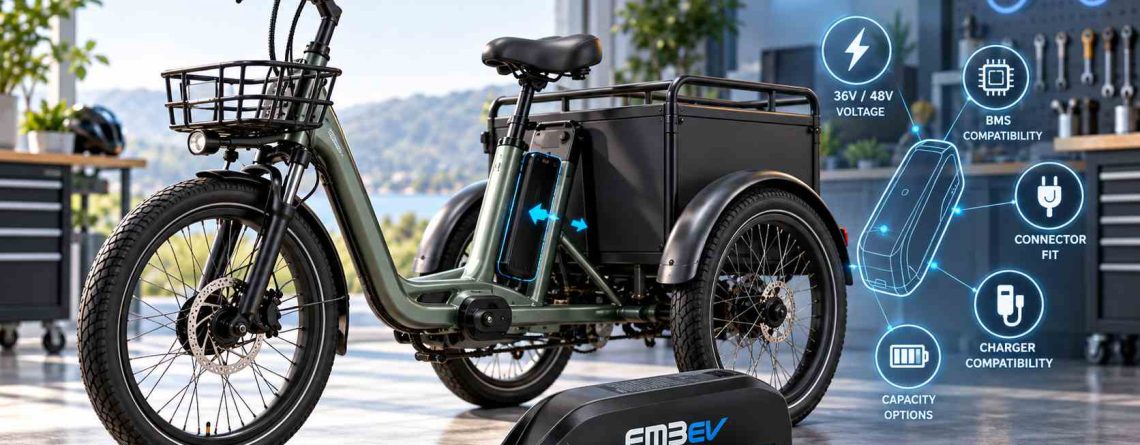
An ebike battery for electric trike use must match the trike’s system voltage, controller demand, BMS capability, watt-hour needs, charger, connector, and mounting space. A battery that fits physically is not automatically electrically compatible.
Quick Answer
- Match battery voltage to the trike and controller system first.
- Check that BMS output can support controller current demand.
- Use Wh, rather than Ah alone, to compare stored energy.
- Verify charger, connector, polarity, dimensions, and mounting method.
- For heavier trikes, consider both energy capacity and current capability.
Imagine two battery packs on a workbench. Both say 48V. Both look as though they could fit an electric trike, and both have connectors that appear usable.
It is easy to conclude that either pack should work. But voltage printed on the case is only the beginning of the compatibility check.
One battery may have a BMS that suits the controller while the other may reach its protection limit when the trike accelerates under load. One charger may be correct while another is not. The same-looking connector may even have different wiring or polarity.
And then there is fitment. A larger battery may offer more stored energy but still be a poor choice if the enclosure interferes with the frame, rack, seat, cable routing, or removal path.

What Makes an eBike Battery for Electric Trike Different?
Electric trikes can place different demands on a battery because total load, repeated starts, controller requirements, and mounting constraints all influence pack selection.
The cells inside the pack do not know whether they are powering two wheels or three. What changes is the vehicle around them.
An electric trike may carry a rider plus cargo, use a larger chassis, or spend more time accelerating from low speed. Some trikes are used for errands and utility work, while others are designed for comfortable long-distance riding.
None of those conditions automatically means that a trike needs a unique battery chemistry or a special voltage. They simply make it more important to evaluate the whole electrical system instead of choosing by Ah alone.
Electric Trike Battery vs a Standard Two-Wheel eBike Battery
A normal eBike battery can potentially work on an electric trike when its electrical specifications and mounting arrangement are suitable.
The key difference is the application. A trike can have a different controller, total load, battery location, and riding pattern. A battery that performs well on one eBike should therefore not be assumed to be interchangeable with a trike pack without checking the system.
Why Total Load Matters
More total load can make acceleration and hill climbing more demanding. The controller may request substantial current during those conditions, which means battery selection must consider both stored energy and the current the pack and BMS are designed to provide.
Why Starts and Hills Matter
Low-speed starts and climbing can be demanding conditions for an electric drivetrain. This is one reason motor wattage alone is not enough to choose an electric trike battery.
The controller determines how the system asks the battery to deliver power, so its requirements need to be checked directly.
Battery Placement and Mounting
Three-wheel frames may provide different mounting opportunities from a conventional bicycle, including downtube, rack-area, frame, or custom mounting locations.
More available space can be useful, but the pack must still be retained securely, protected from interference with moving parts, and positioned so that wiring and connectors are not under strain.
Does an electric trike need a special battery?
Not necessarily. The battery needs to meet the trike’s voltage, controller, BMS, charger, connector, capacity, and mounting requirements.
Can a regular eBike battery work on an electric trike?
Yes, when the complete electrical system and physical installation are compatible. A battery being sold for an eBike does not automatically make it suitable or unsuitable for trike use.
Does a heavier trike need a larger battery?
It may benefit from more stored energy, but the correct capacity depends on load, terrain, riding speed, stop-start frequency, and desired range rather than vehicle weight alone.
How to Choose the Right Electric Trike Battery
Check the battery in this order: voltage → controller current → BMS → Wh → connector and charger → physical fit.
This order matters. Starting with the biggest capacity number often leads to unnecessary confusion because capacity cannot compensate for an incompatible electrical system.
- Confirm the trike’s nominal system voltage.
- Check the controller’s current requirements.
- Verify the battery BMS continuous-current capability.
- Estimate the Wh needed for the intended use.
- Confirm connector type and polarity.
- Confirm charger compatibility.
- Measure the available mounting space.
- Recheck all critical specifications before installation.
Match Electric Trike Battery Voltage First
Voltage is the first compatibility gate. The battery, controller, charger, display, and other electrical components operate within a designed voltage range.
That means a different voltage should not be treated as a simple capacity upgrade. A 48V system should use a battery that is appropriate for that 48V electrical system unless the relevant components have been verified for another voltage.
Also distinguish nominal voltage from full-charge voltage. Battery labels typically describe the nominal system, while the pack operates across a wider voltage range during use.
Can I use a different-voltage battery on my electric trike?
Only when the controller and the rest of the electrical system are verified for that voltage. Never use connector fit alone as evidence of voltage compatibility.
Can a 52V battery replace a 48V trike battery?
Only if the controller, charger, display, and other relevant system components are designed to support the 52V pack.
Why should the controller voltage range be checked?
The controller is a key part of the electrical system and must be able to operate within the battery’s actual voltage range.
Match BMS Output to the Controller
The electric trike battery BMS monitors and protects the pack. Its output capability should be suitable for the current demanded by the controller.
If controller demand exceeds what the battery or BMS is intended to provide, the system may experience protective cutoff or poor operation during demanding conditions.
This is why electric trike battery controller compatibility should be checked using verified controller requirements rather than motor wattage alone.
What BMS rating does an electric trike battery need?
Use a BMS whose verified continuous-current capability is appropriate for the controller and battery configuration. There is no single universal current rating for every electric trike.
What if the controller asks for more current than the BMS allows?
The pack may enter protection or the system may operate poorly under load. Exact behavior depends on the battery, BMS, controller, and operating conditions.
Does motor wattage alone determine battery requirements?
No. Controller settings and system design also matter, so the controller should be part of every battery compatibility check.
Choose Capacity With Wh, Not Ah Alone
Electric trike battery capacity is easier to compare when expressed in watt-hours.
Wh = V × Ah
Watt-hours combine voltage and amp-hours into an energy figure. This makes electric trike battery watt hours more useful than Ah alone when comparing batteries operating at different nominal voltages.
However, Wh still does not guarantee a fixed riding distance. Electric trike battery range depends on variables such as rider and cargo load, speed, hills, temperature, tire pressure, repeated starts, riding style, and overall drivetrain efficiency.
How much battery capacity does an electric trike need?
There is no universal Ah requirement. Define the intended riding load, terrain, speed, and desired range, then compare suitable batteries by Wh after compatibility has been confirmed.
Is higher Ah always better?
No. Ah must be considered together with voltage, and a larger pack still needs to satisfy controller, BMS, charger, connector, and mounting requirements.
What affects electric trike battery range?
Load, terrain, speed, temperature, tire pressure, stop-start riding, riding style, and drivetrain efficiency can all change energy consumption.
Electric Trike Battery Compatibility Checklist
| Check | What to Verify | If Mismatched |
|---|---|---|
| Voltage | Battery vs controller/system | Do not assume compatibility |
| BMS current | Controller demand vs pack capability | Cutoff or poor operation may occur |
| Wh capacity | Intended load and ride profile | Usable range may be insufficient |
| Connector | Type, polarity, and wiring | Do not force or guess connections |
| Charger | Battery and charger compatibility | Use the correct charger |
| Physical fit | Dimensions, mount, and clearance | Battery may not install securely |

Experience Validation Process
A repeatable verification process is more useful than trying to apply one battery rule to every trike.
- Read the existing labels. Record information from the battery, controller, and charger.
- Confirm nominal voltage. Establish the voltage platform before comparing replacement packs.
- Check controller requirements. Use controller specifications to judge the required battery output.
- Measure the available battery space. Record length, width, height, mounting points, connector clearance, and removal path.
- Define the intended use. Consider rider and cargo load, terrain, stop-start frequency, and desired ride distance.
- Compare candidate batteries. Check voltage, BMS output, Wh, connector, charger, and physical dimensions.
- Stop when a critical specification is unknown. Do not use a matching connector or similar case shape as proof of compatibility.
This process is especially useful when replacing a battery on a trike whose original pack is discontinued or when adapting a general-purpose eBike battery to a three-wheel frame.
Can You Use a Different Battery on an Electric Trike?
Yes, but only when voltage, controller/BMS capability, connector, charger, and physical installation are all compatible.
Replacement does not mean the new pack must look identical to the old battery. A different enclosure, capacity, or cell configuration can be considered when the essential system requirements still match.
The mistake is treating one matching characteristic as proof that the whole battery is suitable.
For example, a battery may share the original voltage but be physically too large. Another may fit the available space but use a BMS that is not suited to the controller. A third may satisfy the electrical requirements but require a different charging arrangement.
Electric Trike Replacement Battery
When choosing an electric trike replacement battery, document the original system first. That gives you a baseline for judging alternatives rather than selecting a pack and trying to adapt the trike afterward.
A replacement battery for electric trike use should pass the same compatibility sequence regardless of whether the replacement is intended to restore the original ride or increase usable energy.
Can I put a different battery in my electric trike?
Yes, but verify voltage, controller requirements, BMS capability, connector polarity, charger, dimensions, and mounting before using the replacement.
What should I match before replacing a trike battery?
Match the electrical system first. Then verify charging, connector, dimensions, mounting, and energy capacity.
Does the same connector mean the battery is compatible?
No. Connector appearance does not confirm voltage, polarity, current capability, BMS behavior, or charger compatibility.
Electric Tricycle Battery Fitment and Mounting
An electric tricycle battery must fit both the available volume and the mounting system.
Check enclosure dimensions, mounting rails or brackets, cable routing, connector access, removal space, and clearance around nearby components.
Electric trike battery fitment becomes particularly important when moving between a Shark-style rail-mounted battery and a larger rectangular pack. The second option can offer a different capacity and mounting profile, but it should only be considered where the trike provides an appropriate location and a secure installation method.
Charger and Connector Compatibility
Electric trike battery charger compatibility should always be verified for the specific battery. An old charger should not automatically follow the old battery into a replacement setup. The CPSC micromobility battery charging guidance also recommends using only a charger provided with or recommended for the device and confirming that replacement batteries are suitable for the system.
Likewise, electric trike battery connector compatibility includes more than connector shape. Verify polarity, wiring, current suitability, and the complete battery-to-controller connection.
Use / Do Not Use This Battery
- Voltage matches the system: YES / NO
- BMS supports controller demand: YES / NO
- Charger is compatible: YES / NO
- Connector and polarity are verified: YES / NO
- Battery fits and can be mounted securely: YES / NO
Any NO or UNKNOWN: stop and verify before using the pack.
Two EM3ev Battery Options to Consider
These two options cover two useful electric-trike scenarios: a conventional 48V rail-mounted installation and a larger 52V rectangle-pack installation. They are not universal trike batteries. Select one only after the compatibility checks above are complete.
48V System Option

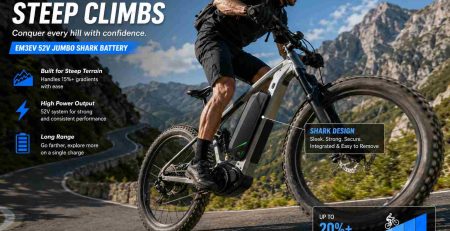
EM3ev Jumbo Shark — 48V 17Ah
A practical candidate for an electric trike already built around a compatible 48V system and a suitable Reention Jumbo rail mounting location.
- System: 48V / 13S
- Capacity: 17Ah
- Energy: 782Wh
- Cells: Samsung 18650-35E
- BMS: 40A smart, temperature-protected BMS
- Mount: Reention Jumbo rail
- Enclosure: IP65-rated case
When it makes sense: Consider this option when the trike is already a verified 48V build, the controller demand is within the pack’s specifications, and the frame provides the required rail space and clearance.
It can be particularly relevant where the trike sees heavier everyday use but still benefits from a conventional rail-mounted battery format.
52V High-Capacity Option
EM3ev Rhino 5P — 52V 25Ah
A larger rectangle-pack option for a verified 52V electric-trike system where higher stored energy, strong output capability, and flexible mounting space are priorities.
- System: 52V / 14S
- Capacity: 25Ah
- Energy: 1260Wh
- Cells: Samsung 21700 cells
- BMS: 40A+ smart BMS with temperature protection
- Format: Rectangle pack
- Enclosure: IP65-rated protection
When it makes sense: Consider the Rhino 5P only when the complete trike is designed for a 52V battery and there is enough secure mounting space for a larger rectangle pack.
Its larger energy capacity makes it more relevant to long-distance, heavier-load, or higher-energy applications than a compact pack, but that advantage only matters when voltage, controller, connector, charger, and mounting are all compatible.
Compatibility note: These products are examples for different verified electrical systems, not interchangeable upgrade steps. Do not replace a 48V battery with a 52V battery unless the controller and all relevant system components are designed for the 52V pack.
Need a Different Voltage or Case Style?
Browse EM3ev battery packs by voltage and compare the pack format, capacity, BMS capability, and mounting arrangement against your trike before selecting a model.
Electric Trike Battery FAQ
For most electric-trike battery questions, check system compatibility first and capacity second.
Does an electric trike need a different battery from an eBike?
Not automatically. The correct pack depends on system voltage, controller demand, BMS capability, charger, connector, required energy, and physical fit. A conventional eBike battery can potentially work when all of those requirements match.
Can I put a different battery in my electric trike?
Yes, but a different battery should only be used after confirming voltage, controller/BMS compatibility, connector polarity, charger, dimensions, and mounting. A matching plug or similar case does not prove compatibility.
What voltage battery does an electric trike need?
Use the nominal voltage required by the trike’s electrical system. Confirm the controller and existing system specifications instead of choosing a higher voltage simply for more performance.
How much battery capacity does an electric trike need?
There is no universal Ah value. Estimate the required energy in Wh based on intended load, terrain, speed, stop-start riding, and desired range, then choose among batteries that have already passed the compatibility checks.
Is Wh or Ah more useful when comparing electric trike batteries?
Wh is generally more useful for comparing stored energy because it accounts for both voltage and Ah. Ah alone can be misleading when two batteries use different voltage platforms.
What BMS output should I check for an electric trike?
Check whether the battery’s verified continuous-current capability is suitable for the controller. Avoid choosing a BMS rating from motor wattage alone because controller settings also influence battery demand.
Can I use my existing charger with a replacement electric trike battery?
Only when the charger is verified as compatible with the replacement battery. A matching charging plug does not confirm that the charger is electrically suitable for the new pack.
How do I know whether an electric trike battery will fit?
Compare verified battery dimensions with the available space, then check mounting points, cable routing, connector access, removal clearance, and surrounding moving parts before installation.
Conclusion
A good electric-trike battery match comes down to four final checks: voltage, BMS/current capability, usable Wh, and complete fit-and-charging compatibility.
Capacity is often the most visible battery specification, but it should not be the first decision.
Start with voltage. Check the controller against the pack and BMS. Compare the amount of stored energy you actually need. Then confirm the charger, connector, polarity, enclosure, mounting system, and cable clearance.
For a compatible 48V trike with an appropriate rail mounting location, a pack such as the EM3ev Jumbo Shark 1305 can provide one route to a conventional downtube-style installation.
For a verified 52V system with more available mounting space and a greater energy requirement, a larger rectangle pack such as the EM3ev Rhino 5P represents a different approach.
Neither choice should begin with the product name. Begin with the trike’s requirements, eliminate incompatible batteries, and then compare the remaining options.
Compare Compatible Battery Options
Browse EM3ev battery packs by voltage and case format, then compare each option against your controller, charger, connector, and available mounting space



LEAVE A COMMENT