




How to Choose an E-Bike Battery
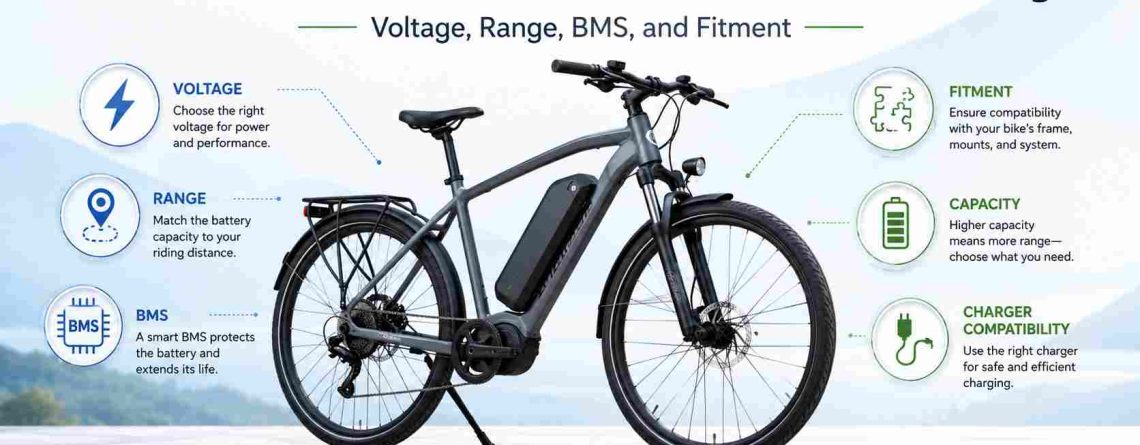
Learning how to choose an eBike battery starts with one rule: match the complete battery to the bike. Before ordering, confirm system voltage, controller battery current, usable watt-hours, BMS and pack current rating, charger output, connector and polarity, case dimensions and mounting clearance.
Many riders compare only voltage and amp hours. These details matter, but they are not enough. You should also check watt hours, BMS protection, discharge current, cell quality, charger compatibility, and physical fitment.
If you already know your voltage, motor type, and frame fitment, you can start by comparing available EM3ev ebike battery options. For Bafang builds, commuter bikes, long-range setups, and high-power DIY projects, choose a pack that matches your system instead of buying by voltage or amp hours alone.
Start With Your Ebike System
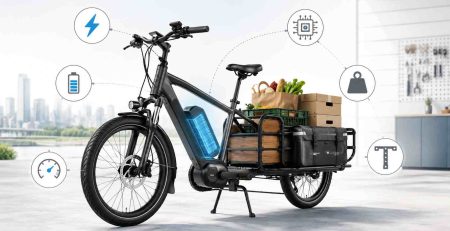
The best ebike battery for one rider may not be right for another. A commuter bike, Bafang mid-drive build, cargo bike, and high-power hub motor can all need different battery specs.
Before buying, check your full system. Look at the motor voltage, controller current, charger, display, connector type, and available frame space. A battery pack with impressive specs is not useful if it cannot safely support your controller or fit your bike.
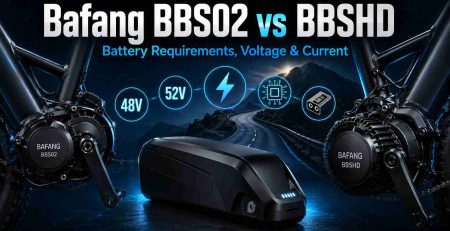
For high-power builds, current rating is especially important. A 1000W ebike motor or Bafang BBSHD setup usually needs more than a basic low-current battery. If you use a Bafang system, read our guide to the best battery for Bafang BBSHD and BBS02.

Choose the Right Ebike Battery Voltage
Voltage is the first specification most buyers check. Common ebike battery voltages include 36V, 48V, and 52V. Some high-power systems use higher voltages, but 48V and 52V are common for many DIY builds.
A 48V ebike battery is a popular choice because it offers a good balance of range, power, and compatibility. A 52V ebike battery may feel stronger on compatible systems. It can offer better voltage headroom and a more responsive ride.
Do not choose a higher voltage just because it sounds better. Your controller, display, charger, and motor must support it. If your bike was built for 48V, do not assume a 52V battery will work safely.
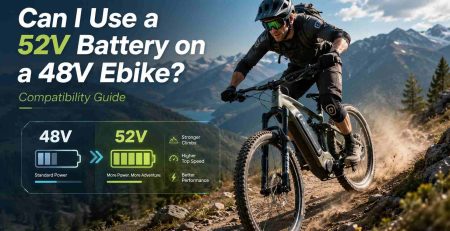
Many riders ask whether they can upgrade from 48V to 52V. The answer depends on the controller, display, charger, low-voltage cut-off, and overall system design. For a more detailed explanation, read our guide on can I use a 52V battery on a 48V ebike.
For a broader comparison of performance, full-charge voltage, range and controller requirements, see our 48V vs 52V eBike battery guide.
Before ordering a replacement ebike battery, check your old battery label, charger label, controller label, or bike manual. Matching voltage correctly is one of the easiest ways to avoid costly mistakes.
Compare Ah, Wh, and Real Range
Battery capacity is often shown in amp hours, or Ah. A higher Ah rating usually means more stored energy, but Ah alone can be misleading. To compare ebike battery range more accurately, look at watt hours, or Wh.
Watt hours are calculated by multiplying voltage by amp hours. For example, a 48V 20Ah ebike battery has about 960Wh. A 52V 20Ah ebike battery has about 1040Wh. This makes Wh a better number for comparing range.
Real range depends on many things. Rider weight, speed, hills, tire type, wind, temperature, assist level, throttle use, and motor efficiency all matter. A rider using low pedal assist on flat roads may get much more range than a rider using throttle on steep hills.
If range is your main concern, choose enough watt hours for your normal ride with some reserve. For more detail, read our guide on how many miles an ebike battery lasts or our article on how many Ah you need for an ebike battery.
Check Discharge Current and Power Delivery
Discharge current is very important if you care about acceleration, hill climbing, throttle response, or high-power riding. It tells you how much current the battery can safely provide to the controller and motor.
A battery can have enough capacity for long range but still feel weak under load. This can happen when the cells or BMS cannot provide enough current. The result may be voltage sag, heat, poor acceleration, or BMS cut-offs.
For a low-power commuter bike, this may not be a major issue. For a 750W, 1000W, or 1500W ebike motor, it matters much more. A high-discharge ebike battery can support stronger current delivery on compatible systems.
The battery does not create motor torque by itself, but the complete pack must support the controller’s current demand. For more help, read our eBike battery BMS guide or our article on choosing a battery for a 1000W eBike motor.
Understand the BMS
The BMS, or battery management system, is one of the most important parts of an ebike battery. It helps protect the battery pack from overcharge, over-discharge, overcurrent, short circuit, and other risks.
A good BMS should match the cells and the expected current demand. If the BMS current rating is too low for your controller, the battery may cut off during acceleration or climbing. This is common when a low-current pack is used on a high-power build.
When comparing ebike batteries, check whether the seller gives clear BMS information. You should be able to see the voltage, Ah, Wh, discharge current, charge current, charger requirement, and connector type.
For more detail, read our guide to ebike battery BMS protection. For broader safety concerns, see our article on whether ebike batteries are safe.
Think About Voltage Sag
Voltage sag happens when battery voltage drops under load. Some drop is normal. Too much sag can make the bike feel weak, especially during acceleration, hill climbing, or heavy throttle use.
Voltage sag is affected by the exact cell model, age, temperature, current per parallel group, interconnects and pack design. Choose a completed pack whose documented continuous rating exceeds the controller demand with appropriate margin.
If your bike feels strong on a full charge but weak as the battery level drops, voltage sag may be part of the problem. To learn more, read our guide on ebike battery voltage sag.
Compare Cell Quality and Long-Term Value
Two ebike batteries with the same voltage and Ah rating can perform very differently. Cell quality, BMS design, wiring, assembly, and quality control all affect real-world performance.
A poorly documented battery may omit the exact cell model, usable capacity, continuous current, charge limit or certification information. Without those details, it is difficult to verify compatibility, performance or long-term value.
Compare exact cells, watt-hours, continuous and peak limits, BMS functions, construction, applicable independent certification, warranty and after-sales support. Price alone does not establish quality or safety.
If you are comparing specifications and value, read our eBike battery buying guide. You may also find our article on 18650 vs 21700 eBike battery cells useful.
Check Fitment, Charger, and Connectors
A battery can have the right voltage and capacity but still be wrong if it does not fit your bike. Check your frame space, mounting points, cable routing, suspension clearance, and battery removal direction before ordering.
Common ebike battery formats include downtube batteries, rear rack batteries, and triangle batteries. A downtube pack may be clean and easy to remove. A triangle battery may offer more capacity for some DIY builds.
Charger compatibility is also important. A 48V charger is not the same as a 52V charger. The charger voltage must match the battery. You should also confirm the charge port, discharge connector, cable length, and polarity.
Avoid unsafe adapter chains on high-current systems. Poor connectors can create heat, resistance, and reliability problems. For a full checklist, read our guide on what to check before buying an ebike battery.

Choose Based on Riding Style
Your riding style should guide your battery choice. A commuter may care most about range, safety, easy charging, and long cycle life. A performance rider may care more about discharge current, voltage sag, and BMS rating.
For daily commuting, choose a reliable pack with enough range for your route and some reserve. For hill climbing, cargo use, or heavy throttle riding, choose a battery that can support higher current without excessive sag.
For Bafang BBSHD, BBS02, or other high-power systems, do not choose by Ah alone. Match the battery to the controller current, motor power, and riding load.
Common Ebike Battery Buying Mistakes
Many problems come from choosing a battery based on only one number. The most common mistake is buying the highest Ah battery without checking voltage, BMS current, charger compatibility, connector type, and fitment.
Another mistake is assuming all batteries with the same voltage and capacity are equal. Two 48V 20Ah packs can differ substantially in exact cell model, usable energy, continuous current, construction, BMS configuration, documentation, certification and support.
- Check that battery voltage matches your system.
- Use watt hours to compare real capacity.
- Match BMS current to your controller demand.
- Confirm charger and connector compatibility.
- Measure frame space before ordering.
- Compare cell quality and long-term value.
Recommended Process for Choosing an Ebike Battery
- Check your original battery voltage or controller voltage range.
- Confirm your motor power and controller current rating.
- Estimate your range needs using watt hours.
- Choose a battery format that fits your frame.
- Check continuous and peak discharge current.
- Review BMS protection and current limits.
- Confirm charger voltage and connector type.
- Compare cell documentation, cycle-life conditions, applicable certification, warranty and support.
Once you know your voltage, capacity, fitment, and current needs, compare suitable battery packs based on your riding setup. Look for the right balance of range, BMS protection, discharge current, cell quality, and physical fitment before choosing a pack.
FAQ About Choosing an Ebike Battery
What is the most important thing when choosing an ebike battery?
Compatibility is the most important factor. The battery must match your motor, controller, charger, connector, frame space, and riding needs.
Is a 52V ebike battery better than a 48V ebike battery?
A 52V ebike battery can offer stronger performance on compatible systems. It is not automatically better for every bike. Your controller, display, charger, and motor must support it.
How many Ah do I need for an ebike battery?
The right Ah depends on your voltage, range target, terrain, rider weight, and motor power. For better comparison, calculate watt hours.
Should I buy the cheapest ebike battery?
The lowest-priced battery is not always the best value. Avoid packs that omit the exact cell model, watt-hours, continuous current, BMS limit, charger requirement, connector or warranty.
Final Thoughts
The best eBike battery is the documented pack that matches the controller, charger, connector, frame, current demand and range target. Preserve the original system voltage unless every voltage-sensitive component is approved for a change, and verify current product specifications before ordering.







LEAVE A COMMENT